

Scientists Say Human Cloning Not Their Goal, After Cloning Monkeys For The First Time
At that place'southward a variety of things that come up to my heed when I think of cloning – sci-fi alien movies, Dolly the sheep, the genetic engineering ranch from South Park. Something that is still far from my skeptic imagination is a clone of myself – or the clone of any human being. Just in an astonishing tale of twists, the scientific community has been able to create a healthy clone of ane of the primate species – a monkey – for the first time after several failures.
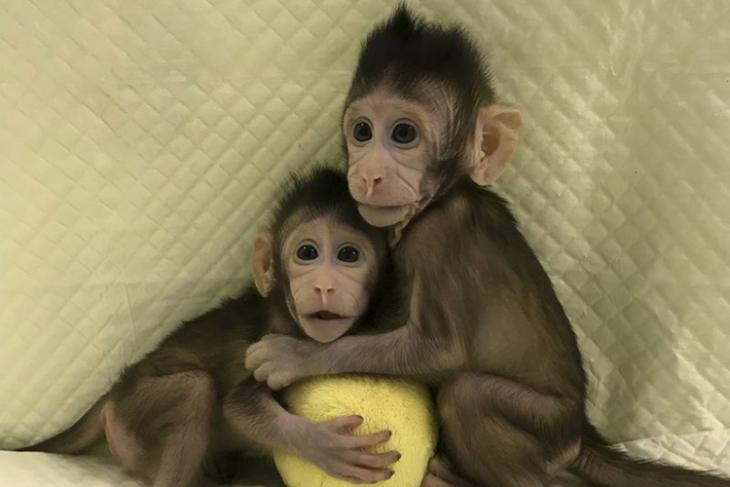
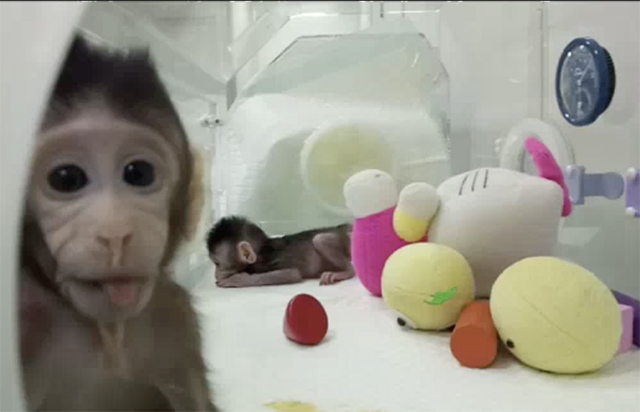
Genetic pioneers at the Chinese University of Sciences in Shanghai have reportedly been able to successfully clone a macaque, breeding two identical baby monkeys from one fetus. This development was published in the Biology journal Jail cell. The two female infants have been named Hua Hua and Zhong Zhong and are viii and seven weeks one-time respectively. "Information technology's been a long road," said ane of the scientists, while another added "the bulwark of cloning primate species is at present overcome."
Although the accomplishment of cloning apes has rendered a theoretical possibility to the cloning of humans, the cold truth is that the process of breeding monkeys in a lab is far from optimal. But 2 babies were built-in out of 127 fertilized eggs. Moreover, the outcomes of trying to clone an developed monkey have not been fruitful, particularly considering of the challenging aspects of the process. Cloning monkeys involved scooping away of the immature DNA from monkey eggs and filling them with DNA from a fetus. As the egg cell grows into an early is then placed within a female person monkey.
Scientists hope that cloned animals would help advancing certain medical research. Cloned monkeys volition be used in awritten report medicines and treatments for syndromes, starting time with Parkinson's and Alzheimer's. The discovery, for this reason, has met flak from People for the Ethical Treatment of Animals or PETA.
Developing humans the same style is something scientists don't actually want to do – not at least right at present. This is considering the procedure of factor manipulation of homo embryos, many scientists believe, volition lead to human rights and ethics debates – and it rightly should if science breeds physically or mentally peculiar humans who are not acceptable to the society. This also leaves room for examination of surrogacy equally an effective way of carrying a cloned fetus.
It might go a reality but only later on scientists have foolproof means of creating efficient and desirable monkeys, and subsequently humans.

Source: https://beebom.com/scientists-no-human-cloning-after-cloning-monkeys/
Posted by: johnsonshonswer.blogspot.com
0 Response to "Scientists Say Human Cloning Not Their Goal, After Cloning Monkeys For The First Time"
Post a Comment